
Australians know a good flat white when they sip one. It’s practically baked into our DNA. Considering Melbourne is the heartland of appreciated flat whites worldwide, Australian home baristas have a bit of a reputation to uphold when they get out the steam wand.
The perfect flat white is simple to make, but not necessarily easy. The balance of components and the quality of the shot, the milk, and the beans themselves all contribute to creating the best caffeinated drink this side of the equator. Because of this, the flat white is also an excellent drink on which to test your chops as a growing barista.
So, let’s get that flat white of yours up and running. We’ll walk you through what a flat white is and how to make one on a home espresso machine. We’ll also give you tips on milk texturing and suggest a couple of variations to try if you’re creating a signature beverage.
(You’ll need a home espresso machine for this breakdown, so make sure it’s clean and ready to go before we begin.)
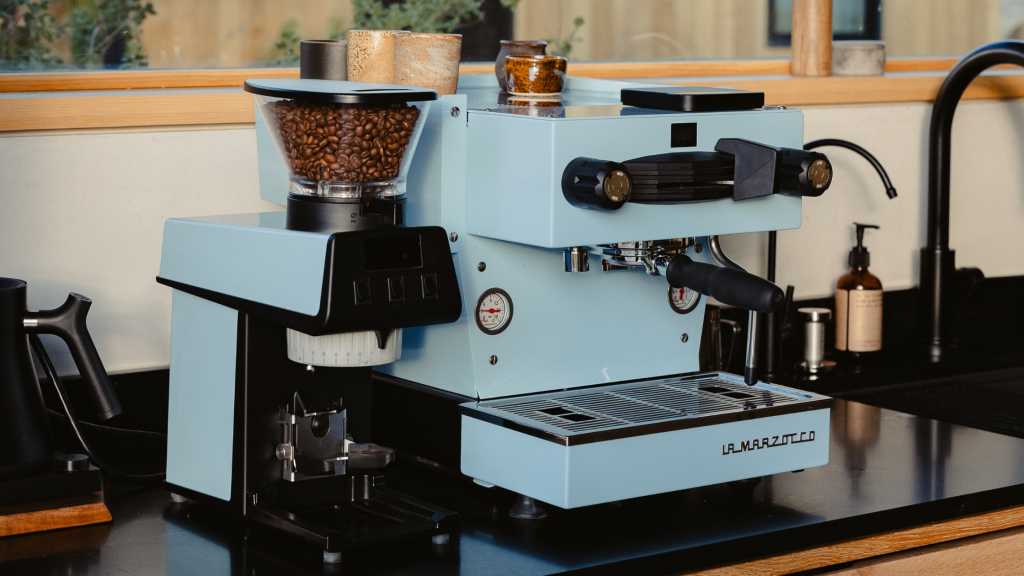
What is a flat white?
Let’s begin at the beginning.
A flat white exists in a bit of a state of confusion. Many people confuse it with a latte or a cappuccino while ordering, but any true Australian barista knows that a flat white is made or missed in a single component: the milk texturing.
Any standard café latte is served in a 220ml glass, with a shot of espresso topped off by a thin layer of microfoam. A cappuccino has a deeper, airier head of stiff foam, usually dusted with chocolate or cinnamon.
A flat white is different. You serve this drink in a smaller cup, topping a double shot of espresso with liquid velvety microfoam with the thinnest layer of actual foam you can manage.
Because there’s technically less milk than in a latte, the bold characteristics of the espresso beans cut through, only slightly muted by that microfoam.
So, velvety milk and the tiniest layer of foam you can manage. How do we get there?
Your Guide to a Perfect Flat White
1: Pull the perfect shot.
As with any other drink, the quality of your espresso shot matters a lot. The goal of a flat white is to draw out the gorgeous, underlying notes of the bean while heading off any bitterness, hence the texture of the milk.
There’s no massive volume of milk to hide behind, as you might have with a latte, or any sugar to dampen bitterness, as with a mochaccino. So, you need to pull a top-notch shot.
We recommend an 18-gram dose, locked into your home espresso machine and tamped carefully. If you have a distribution tool, feel free to use it; this will prevent channelling and keep your puck completely level.
While you brew, you’re aiming for a classic 1:2 ratio, so about 36 grams of liquid espresso. This shouldn’t take more than 30 seconds or less than 25. Watch for that gorgeous crema, and you know you’ve got it in one.
If you really want to get clever, pour the shot into a pre-warmed ceramic cup to preserve the crema’s structure.
2: Nail your milk texturing.
Now, the tough part. Your milk texturing defines your flat white, so it’s important to know what your home espresso machine can manage in terms of steam pressure. If you’re working with any La Marzocco model, you should be good to go, but out-of-the-box models might require a touch of creativity.
You want milk that’s glossy and velvety, almost like wet paint. This means aerating the milk first, then texturising it to get that perfect shine.
Choose your milk and ratio.
The type of milk you choose matters a lot, as it will determine how it responds to steam. Generally speaking, you can choose between standard full-cream milk from the supermarket and plant milks.
Now, standard plant milks like oat or soy aren’t made to be steamed, so you run the risk of curdling or separating the milks as you steam them. Dairy milk that isn’t full-cream also won’t hold the microfoam structure nearly as well as a full-cream blend.
For this reason, your best bet is to use barista-formulated dairy or plant milk to get the best flat white result. If you’re using dairy, full-cream milk will also work.
As for the ratio, a true flat white isn’t served in anything larger than a 170ml cup. The ideal ratio therein should hover around one-third coffee to two-thirds silky, steamed milk.
Stretch your milk.
Use a stainless steel jug for your milk texturing. Fill with cold, fresh milk, then submerge the tip of your steam wand at a roughly 45-degree angle. Tilt the jug at a slight angle as well to get that spinning vortex going.
Once you’ve done that, turn on the steam to full pressure. Flat whites only need about 2 to 3 seconds of aeration, so listen for those telltale hissing sounds.
Milk texturing.
After you’ve introduced the air, get the wand deeper into the milk. The goal is to use the fierce, dry steam output of your home espresso machine to texturise the milk.
Get it spinning! That spinning action shreds the air bubbles and distributes them throughout the milk, creating an ultra-smooth result. Once the base of your jug is too hot to touch comfortably, shut off your steam. You’re done.
Tap, swirl, and pour.
Finally, give the base of the jug a firm, sharp tap on your benchtop to pop any stray air bubbles. Next, swirl the jug continuously in a smooth, circular motion. From there, tilt your espresso cup slightly and pour a thin, steady stream of milk into the espresso, moving the jug in tiny circles.
Once the cup is about three-quarters full, lower the spout of your jug as close to the surface of the liquid as you can, and tilt the cup flat. Gloss the top of your beverage with a thin layer of that microfoam, and you’ve done it! You’ve got a flat white.
3: Add a signature.
While it’s not essential, it can be fun to experiment with your home espresso machine to find a signature style for your flat white.
For example, if you’re after something a bit more intense, a ristretto flat white is a delicious choice. Adjust your grind slightly finer to restrict the flow, aiming for an 18g input to a tight 25g output in 25 seconds. This catches only the brightest sugars and concentrated oils, resulting in an incredibly smooth, velvet-like drink.
You can also learn to do milk texturing on plant milks like oat, almond, or soy. These introduce nuttier flavours into your flat white, which is a real joy if you love a floral top note.
Make the perfect flat white with a La Marzocco home espresso machine.
La Marzocco’s mastery of espresso dates back to Florence in 1927. For modern-day Australians, we’re proud to say that our home espresso machines are still the pinnacle of engineering, giving coffee lovers nationwide the chance to whip up the perfect flat white at any time.
If you don’t already have your home espresso machine on deck, browse our range to find your perfect match today.